












Superintendent sets out to improve elementary school literacy
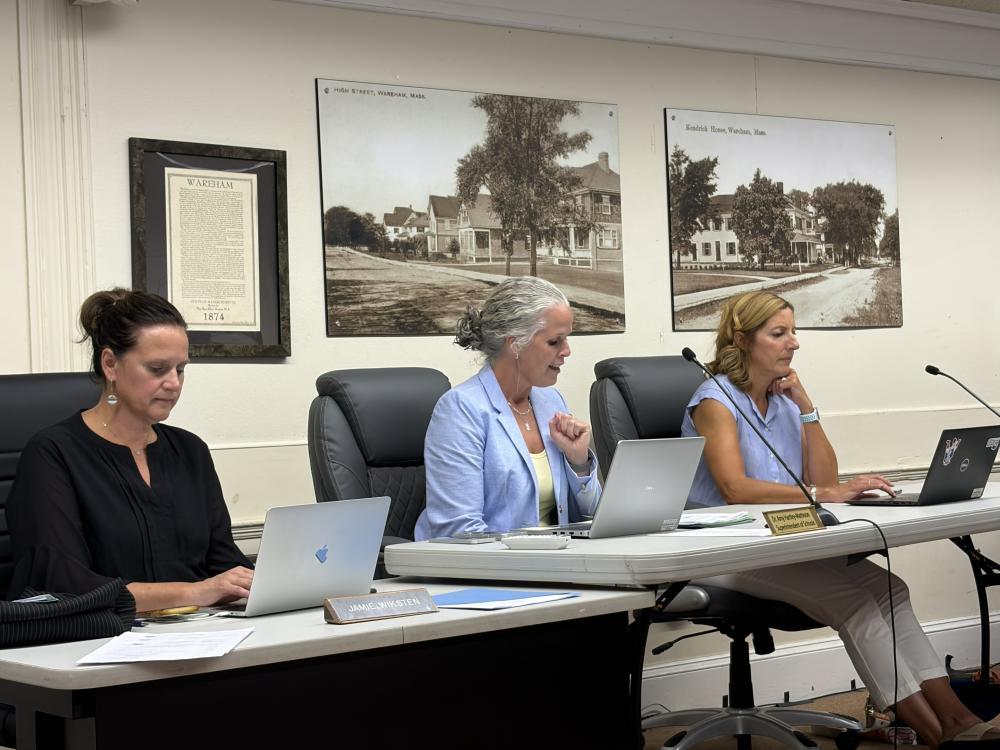 Superintendent Amy Hartley-Matteson at an Aug. 20 School Committee meeting. Photo by Christian Uva
Superintendent Amy Hartley-Matteson at an Aug. 20 School Committee meeting. Photo by Christian Uva
Superintendent Amy Hartley-Matteson at an Aug. 20 School Committee meeting. Photo by Christian Uva
Many Wareham Elementary School students are not reading at grade level. Superintendent Amy Hartley-Matteson is trying to change that.
Hartley-Matteson presented her plan to assess and improve the school’s literature education at the Sept. 3 School Committee meeting. Over the school year, she will review the current system and develop a new school-wide program for teaching reading and writing.
She said she plans to “develop and present a multi-year early literacy action plan” by next August. This plan, which will be implemented across all classrooms, will employ “evidence-based” teaching practices and give teachers benchmarks to measure students’ progress.
Hartley-Matteson will spend the fall and winter looking at the curricula and practices that teachers currently use in the classroom. During the spring months, she’ll work with teachers and administrators to make recommendations to improve literacy education.
She emphasized the pressing nature of this issue in a written statement about her goals. But she said this has to be done coherently.
“Literacy growth is urgent and urgency cannot mean rushing into disconnected actions,” Hartley-Matteson wrote.
The School Committee moved to approve Hartley-Matteson’s literacy goal, as well as her other goals for transitioning into her new role.
“It’s exactly the kind of goal that I think we need,” School Committee Chair Geoffrey Swett said at the meeting.
School Committee Vice Chair Kevin Brogioli said he was glad to get an action plan in 11 months, and that he appreciated Hartley-Matteson’s specificity in how she would devise that plan.
Swett told Wareham Week on Tuesday that “too many children” leave their grade scoring below the grade average on the MCAS and NWEA, two standardized tests. He said it’s a national issue, though, and not specific to Wareham.
He added that the School Committee hired Hartley-Matteson because of the strides she made in student literacy while working as the assistant superintendent in Randolph.
Swett said that there are “no specific numeric goals” for how many kids should be reading at grade level in this plan.