











Gaskey, Hewins face off in state representative race
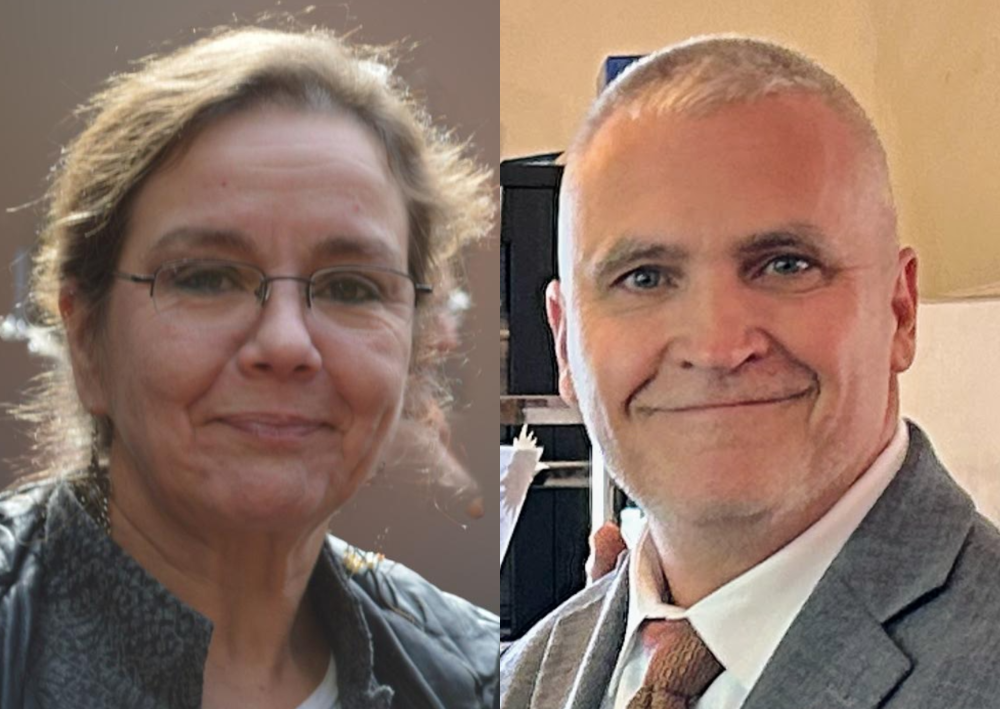 Democrat Sarah Hewins, left, is challenging incumbent Republican John Gaskey, right, for the 2nd Plymouth district state representative seat. File photos
A competitive race for state representative is underway as incumbent State Rep. John Gaskey (R-Carver) is trying to fend off Democratic challenger and Carver Select Board member Sarah Hewins for the 2nd Plymouth district State House seat.
Gaskey was first elected to the legislature in 2024, defeating since-deceased Rep. Susan Gifford (R-Wareham) in the Republican primary and, in the general election, beating Hewins, who ran a write-in campaign after Democrats didn’t nominate a candidate.
Before becoming state representative, Gaskey served 23 years in the Coast Guard and worked in the private sector as an engineer. He is originally from El Paso, Texas, moved to Carver in 2017 and was elected to its Planning Board in 2020.
Hewins is a longtime Carver official with over 25 years of public service. She has served on the Carver Select Board since 2009, was elected twice to the Carver Planning Board and worked as her town’s conservation agent for 15 years. She has run for the State House seat three times before — losing to Gifford in 2016 and 2018 and then to Gaskey in the 2024 write-in bid.
This year’s matchup comes after Gaskey narrowly defeated Carver Select Board member Mark Townsend in September’s Republican primary.
Gaskey, whose district covers Wareham, Carver and southern Middleboro, has called himself an “anti-establishment” conservative while Hewins said she is an “independent-minded Democrat.” The two offer sharply different platforms. Here’s where they stand:
Abortion
Gaskey said it is hard to describe his “ideal” position on abortion.
“I feel strongly that life begins at conception,” he said, but added that exceptions for rape, incest and manipulation should be considered.
Hewins said she “would never interfere with a woman’s right to choose.”
“I don’t think anyone likes abortion, but that issue is between a woman, her doctor, her family and whatever her God is,” Hewins said. “I think that’s a completely private issue and should not be infringed on.”
Auditing the state Legislature
Both candidates said they support an audit of the Massachusetts State Legislature. In 2024, voters overwhelmingly approved a ballot question to allow State Auditor Diana DiZoglio to conduct an audit of the Legislature. However, the audit has been held up as legislative leaders argue an audit violates the separation of powers in the state constitution.
Gaskey said he voted for an audit and has reached out to DiZoglio to offer his support of her audit.
“It’s a function of oversight,” Gaskey said. He noted how the three branches of the federal government provide oversight to each other.
Hewins said her understanding is that the state auditor cannot audit the State Legislature, but that the Legislature cannot audit itself. Hewins said she instead supports an independent, third-party audit of the Legislature.
“The whole point is there needs to be an audit,” Hewins said.
Gun laws
In one of nine referendum questions on this fall’s ballot, voters will decide whether to keep the state’s “Chapter 135” law, which includes several toughened gun control measures. The law increased licensing, training and data collection requirements when owning a gun, regulated 3D printed “ghost guns” and barred adults under 21 from owning handguns or semi-automatic firearms.
Hewins said she supports keeping the current gun safety law but is open to discussion if there are issues with the current law. She said the Gun Owners Action League, a nonprofit Second Amendment advocacy group, should have been included in the conversation when drawing up the law. Hewins said she supports including them when discussing future changes to the law.
“If there are glitches in the current state gun law, my suggestion is that we not throw out the baby with the bathwater,” Hewins said. “Let’s fix the glitches rather than chucking the entire law.”
Gaskey is a firm opponent of the current gun law.
“I am a no on nine,” Gaskey said. “I’m in favor of our Second Amendment rights.”
Gaskey said he believes Chapter 135 targets lawful gun owners “with the ultimate intention of eliminating gun ownership in Massachusetts.”
Affordability & taxes
“The cost of living here in Massachusetts is really getting out of control,” Gaskey said. He said that the state budget should be redesigned to ensure towns have the money they need first, then the state and then any “extras.”
He said he supports lowering taxes.
“Reducing taxes overall and putting more money back into peoples’ pockets just means that they get to spend it in the ways that they want, not necessarily the ways that the government wants us to spend it,” Gaskey said.
“I’m not in favor of raising taxes higher than they are,” Hewins said. “On the other hand, I don’t think we should get rid of it or lower it because we [town governments] can barely pay for stuff as it is.”
Hewins noted how towns have faced a shrinking proportion of state aid to their overall revenue. This phenomenon has played out in Wareham. Since 2024, the town's state aid allocation has not kept up with its increase in costs.
Housing
Both Gaskey and Hewins criticized state-enforced housing policies.
“I’m here to support my constituents and my towns,” Gaskey said. He said housing affordability policy should be determined by what works best in each one.
Alongside State Sen. Kelly Dooner, Gaskey supported a measure in 2025 that would have granted exemptions to some towns regarding the state’s MBTA Communities Act, which required towns near or containing commuter rail lines to zone for multifamily housing. All towns in the 2nd Plymouth district — Carver, Middleboro and Wareham — are subject to the zoning requirements. The proposed exemption policy did not pass.
Hewins said she is opposed to both the state’s MBTA Communities Act and “40B” policies allowing developers to avoid some zoning regulations when constructing lower-cost and higher-density housing. She called both policies “mandates” that fail to consider the needs of smaller towns.